Recently, Aseem, a fellow impact entrepreneur, sent me an article from The Economist titled “The world’s most affordable housing is not where you think”, with a note:
“This is a problem worth solving. Thank God, Prasoon is on it.”
My response was immediate, almost instinctive, and perhaps a little cynical.
“If it were truly worth solving, many others would already be doing it.”

This idea that businesses exist to solve problems is so deeply ingrained that we rarely question it. Every advisor, every investor, every professor will tell you the same thing. Find a real problem. Solve it. The bigger the problem, the bigger the opportunity. It sounds logical, almost scientific, as if markets naturally organise themselves around unmet needs.
Five years ago, I believed this completely, when BillionBricks was founded to build net-zero affordable homes and communities.
The article argues that the economic cost of not providing affordable housing will cause cities like Delhi and Manila to “flounder”. In these cities, almost half the population may be living in slums. But the reality is more uncomfortable. Over the last quarter century, per capita income in Delhi rose by about 22 times and Metro Manila’s by about five times. These cities may have deep housing distress, but their economies have still expanded dramatically. Perhaps they could have grown more with better housing, but clearly they are not collapsing or “floundering”.
The system is functioning well enough without solving this problem.
And yet, I went in believing that solving housing was worth it. That was the business proposition I took to the Philippines. With our model of net-zero affordable housing, the poor would benefit, developers would make more money, and the country would see economic, social, and environmental gains. It looked like a perfect alignment of incentives. It looked like good business.
I raised capital, built an office in Manila, left my family in Singapore and began the journey. The welcome I received from people and institutions in the Philippines only strengthened my belief. They were warm, generous, and encouraging. I was invited into rooms I had no right to be in. Senior leaders made time. No door remained hard to open. Everyone agreed this was a problem worth solving and thanked me for choosing their country and people to help.
So I said, thank you. Let us begin the work.
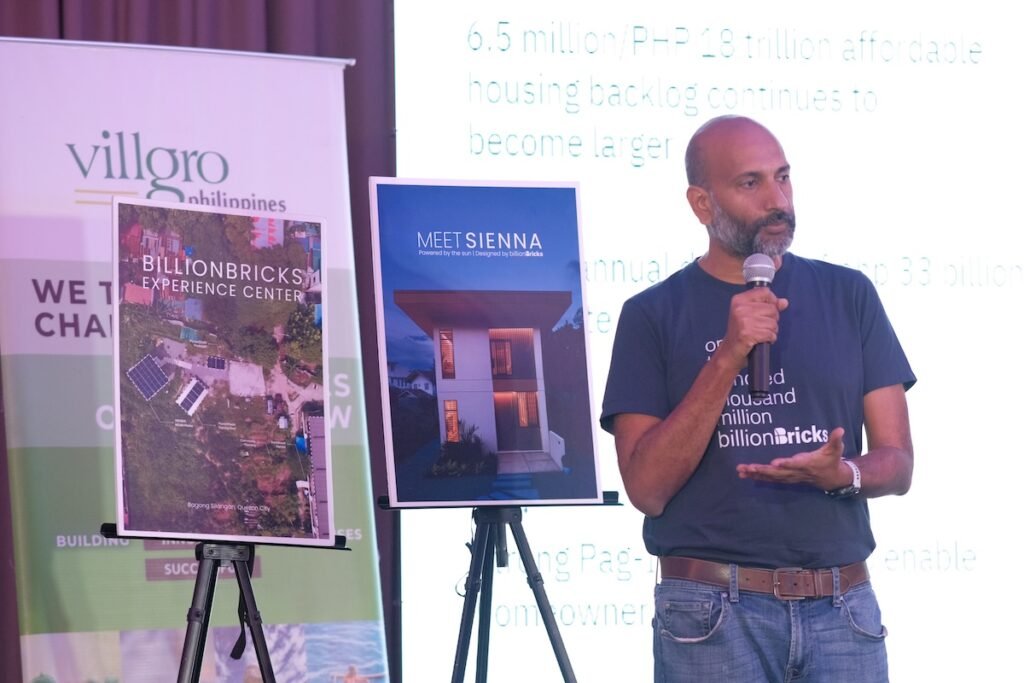
We pitched, negotiated, partnered, learned, and kept repeating this cycle. We signed agreements and memorandums for more than 6,000 homes. On paper, it looked like progress. In reality, sustaining execution proved far more difficult than expected. What followed was not random. It was a sequence of encounters, each one perfectly aligned with business theory, and each one collapsing in practice.
As a small foreign startup, in order to build homes, we needed partners with land, licenses and market access. We brought a new vision, a new product, a new model and capital. The structure was sound. The intent on both sides was positive, and the motivation to solve a worthwhile problem high. The approach we took was grounded in business logic. Every pivot was informed with advise, by experts, by what should work. And our moves were localised by my practical experience from the ground.
And yet, consistently, something held back. The large conglomerates struggled to move beyond their existing structures. We were told, they were too big to need us. Mid sized ones who wanted to break into the next league, struggled to adapt their teams to something new. Next-gen visionary leadership often remained constrained by legacy decision-making. And then there were the lazy ones, the greedy ones and the ones with low morals.
Across all these conversations, there is a pattern which is difficult to ignore. Everyone appreciated the idea. Everyone agreed it mattered. Everyone was willing to engage. Everyone wanted to do something for their country.
But no one wanted to act. Self interest introduced inertia. Business logic was not the constraint. Human behaviour was.
This is where the idea that markets solve meaningful problems begins to break down. Somewhere along the way, someone should have said, this is not perfect, but it is worth doing. What I encountered instead was a system where everyone agrees the problem matters, but no one is willing to act in a way that might actually solve it.
With these thoughts, as I headed home that evening in Singapore, my bus passed by the headquarters of ShopBack. A multi-billion dollar company.
I found myself asking a simple question: What problem did they solve? They built a business around customer acquisition and conversion for merchants such as Amazon, Lazada, Agoda. All these companies already had hundreds of millions of customers. Why did their problem turn out to be more “worth solving” than ours? Why did the human behaviour align so easily for that model, but not housing?
So now when someone tells me housing is a problem worth solving, I no longer find comfort in it.
I have learned, the hard way, that the more a problem is worth solving, the less likely anyone is willing to actually solve it.
We at BillionBricks continue to build, but with a far clearer understanding of what it truly takes to move the system.
Prasoon Kumar is the CEO and Co-founder of BillionBricks, a climate-tech venture pioneering net-zero housing solutions for underserved communities. With a background in architecture and urban planning, he has transformed BillionBricks from a non-profit into a for-profit enterprise, integrating design, technology, and finance to address housing and climate challenges. Prasoon also serves as a Business Advisor to the Director General at the World Trade Organization, focusing on sustainable development and global economic strategies.