At WUF 2026 in Baku, BillionBricks Co-founder and CEO Prasoon Kumar delivered a TED-style keynote challenging the global housing community to stop treating the affordable housing crisis as solely a social problem to be solved through goodwill and advocacy, and start treating it as an economics problem that demands financial solutions.
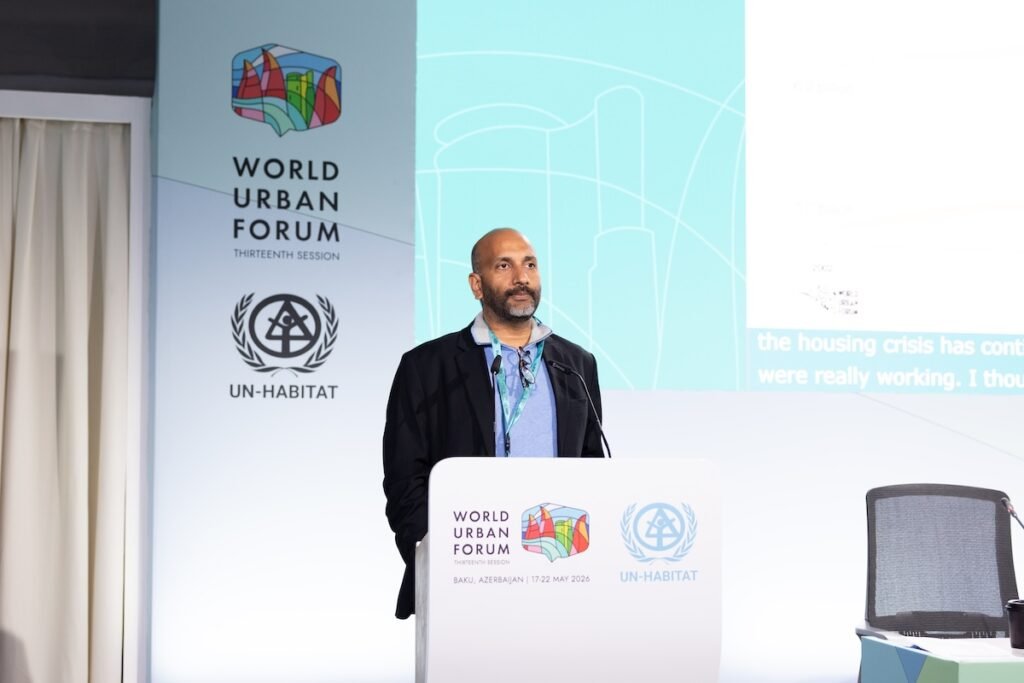
The World Urban Forum has been convening the world’s greatest minds in urban development since 2002. Twenty-four years. Twelve forums. And still, the number of people living in slums and without adequate shelter continues to climb. At WUF 2026 in Baku, BillionBricks Co-founder and CEO Prasoon Kumar stepped up to give a different kind of talk: one drawn not from research papers, but from the bruising reality of trying to build affordable homes.
In a TED-style keynote that closed out Day 1, Prasoon traced his own journey: from a fresh architecture graduate in 2002 who watched the first WUF unfold and thought “they’ve got it covered,” to quitting his career in 2014 to found BillionBricks after the 6th WUF confirmed that the housing crisis was, if anything, getting worse. Then he asked the audience to sit with a question: if twelve years of trying has not worked, what are we doing wrong?
The story of two houses: how affordable housing financing breaks down

To illustrate the structural problem in affordable housing finance, Prasoon walked the audience through a thought experiment. Two buyers, two homes, one city, one developer. The first buyer earns well, gets a mortgage easily, and five years later picks up the keys to a beautiful glass-fronted home. Standard market-rate housing. The economics work perfectly: the developer targets a 20% internal rate of return (IRR), builds a capable team, meets all safety standards, and delivers on time.
The second buyer is the first buyer’s driver, one of millions living in informal settlements on the city’s edge. He earns a fraction of the income and qualifies for a fraction of the loan. The same developer, the same bank, the same ambition to build. But the numbers begin to unravel almost immediately.
Land is unavailable in the city, so the developer is forced to the outskirts, where roads and services have been promised but not delivered. The minimum viable house at the available budget works out to 10 square metres, but the city requires a minimum of 25. There is a $9,000 shortfall. The developer strips the finishes, cuts salaries, brings in volunteers, and reduces risk buffers. Still, when the moment comes to draw down the loan, the bank withdraws. A year has passed. The project is no longer financially viable. It is quietly shelved.
“Not because he lacks intent or compassion or knowledge. The economics of affordable housing just do not work. What we feel are solutions to solving the crisis are actually becoming a hindrance.”
The real barrier to solving the affordable housing crisis
This is the core of Prasoon’s argument: housing is fundamentally an economics problem, and we are trying to solve it with a system whose every part operates rationally and in its own self-interest. Interest rates flow from treasury bonds and move through layers of finance to the borrower. Each party along the way protects its margin, because if it does not, a competitor will. The system works in perfect harmony for market-rate housing, because the risk is manageable and the returns are attractive. Affordable housing breaks that harmony. The risk is higher. The return is lower. Every party that might otherwise participate has a rational reason to step away. The math does not close, and no amount of goodwill changes that.
Climate certification requirements, community consultation processes, green material mandates: Prasoon was not dismissive of these goals, but he drew a sharp distinction. They are meaningful only after we get to actually building the homes. They cannot be prerequisites for starting. Requiring them upfront, as development pandits and institutions increasingly do, adds cost and delay to a budget that has no room for either.
He invoked the Tata Nano as a cautionary parallel. The $2,000 car designed for India’s poorest families famously failed because it treated the poor as a different kind of consumer requiring a different kind of product. The lesson for affordable housing: do not design a second-class system for people who desire a first-class solution.
What actually works: solar energy as the financial solution for affordable housing
Prasoon did not leave the audience without hope. He described how the BillionBricks team found a path through the economics by building a solar rooftop power plant into every affordable home. These systems produce five times more energy than the household consumes. The surplus energy is sold back to the grid, generating an additional revenue stream for the project. On a $25,000 home, this generates approximately $25,000 in additional income over 25 years. That is enough to push the IRR for affordable housing projects to 18%, bringing them on par with market-rate development.
On paper, it works. Climate goals align. Banks become interested. Affordable housing starts to look like infrastructure finance. Prasoon took the idea back to the development finance institution. They praised it. They called it innovative, scalable, and a wonderful pilot. There was just one final question before they could proceed: who covers the innovation risk? Not the land risk, not the construction risk, not the borrower risk. The innovation risk. A new category of hesitation, for a project that had already survived every other kind.
And that is how the housing crisis continues.
A new KPI for the global housing community

Prasoon closed with a challenge to everyone in the room. He asked that when delegates return for the next World Urban Forum, the measure of success should not be papers published, conferences attended, or people trained. It should be one number: how many homes did we build?
It was a pointed ask, the kind that only someone who has spent a decade trying and failing can credibly make. At BillionBricks, we are committed to that KPI. Solving the affordable housing crisis means treating it as the economic design challenge it is. It means finding models that work within the logic of capital rather than hoping that logic will change on its own.
The affordable housing crisis will not be solved by goodwill alone. But it can be solved, if we are honest about the problem.